
Loading lot details…
The November 2026 Auction: Part 4
Swipe left for previous · Swipe right for next
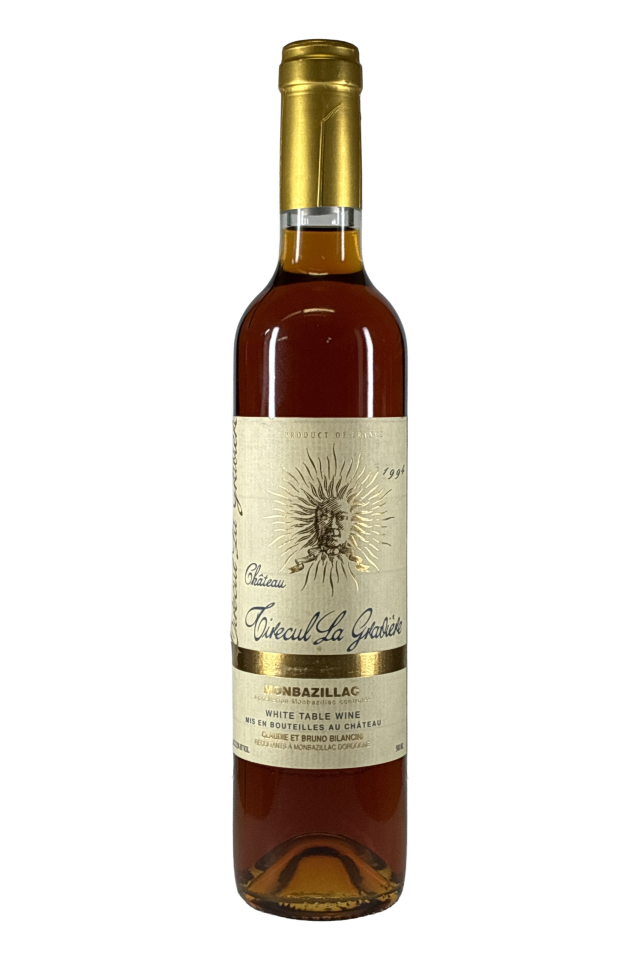 1 / 2
Lot 6152
Estimate: $160
Lightly wrinkled capsule, lightly scuffed label.
Next Bid
Opening Bid
Sign in to place bids and add to your watchlist.
Login to BidCollection name
Reviews
92RP
". . . possesses a fabulous, intense perfume of exotic fruits and honey, as well as amazing richness, purity, and a level of concentration and balance that must be tasted to be believed. Already approachable, it is capable of lasting . . . . Sadly, only 50 cases were produced for the world. Monbazillac is well-known in French history, but my experience in tasting through the appellation's wines has unearthed few gems. Leave it to Eric Solomon to discover this remarkable estate. The vineyard is planted with a high percentage of Muscadelle (50%), along with Sémillon (45%), and Sauvignon Blanc (5%). There are two cuvées produced. The young vine cuvée (the vines are 45-years old) produced only 8.5 hectoliters per hectare in 1994 (less than one-quarter ton of fruit per acre). Additionally, these grapes are picked grape by grape (as they develop the noble rot), not by bunch. The proprietors, Claudia and Bruno Bilarcini, actually pass through the vineyard a minimum of four to five times a day. Given the fact that it is a manual harvest, the 1994 was harvested between October 20 and November 25. Fasten your seat belts, as these wines are remarkable. Admittedly, with microscopic vinifications such as this, it is easier to achieve near perfection. In spite of the tiny production, wines such as this need to be brought to the attention of my readers. Moreover, recognition of such extraordinary efforts only encourages other highly enthusiastic overachievers to attempt similar ventures. It is an understatement to say these are the greatest wines I have ever tasted from Monbazillac; in fact, they are among the greatest sweet wines I have tasted - from anywhere!"
Region
Sweet
Country
Score
". . . possesses a fabulous, intense perfume of exotic fruits and honey, as well as amazing richness, purity, and a level of concentration and balance that must be tasted to be believed. Already approachable, it is capable of lasting . . . . Sadly, only 50 cases were produced for the world. Monbazillac is well-known in French history, but my experience in tasting through the appellation's wines has unearthed few gems. Leave it to Eric Solomon to discover this remarkable estate. The vineyard is planted with a high percentage of Muscadelle (50%), along with Sémillon (45%), and Sauvignon Blanc (5%). There are two cuvées produced. The young vine cuvée (the vines are 45-years old) produced only 8.5 hectoliters per hectare in 1994 (less than one-quarter ton of fruit per acre). Additionally, these grapes are picked grape by grape (as they develop the noble rot), not by bunch. The proprietors, Claudia and Bruno Bilarcini, actually pass through the vineyard a minimum of four to five times a day. Given the fact that it is a manual harvest, the 1994 was harvested between October 20 and November 25. Fasten your seat belts, as these wines are remarkable. Admittedly, with microscopic vinifications such as this, it is easier to achieve near perfection. In spite of the tiny production, wines such as this need to be brought to the attention of my readers. Moreover, recognition of such extraordinary efforts only encourages other highly enthusiastic overachievers to attempt similar ventures. It is an understatement to say these are the greatest wines I have ever tasted from Monbazillac; in fact, they are among the greatest sweet wines I have tasted - from anywhere!"
Have questions?
French wine covers a remarkable range of styles, from the structured reds of Bordeaux to the sparkling wines of Champagne, where a second fermentation in the bottle creates the bubbles. Bordeaux is best known for red blends built around Cabernet Sauvignon or Merlot, but it also makes dry whites and the sweet wines of Sauternes. Burgundy is a benchmark for Pinot Noir and Chardonnay, with wines that can taste distinctly different from one village to the next. The Rhône Valley offers a contrast within a single region: Syrah shapes the reds of the north, while Grenache often leads the blends of the south. In the Loire Valley, Chenin Blanc can be dry, sweet or sparkling, while Cabernet Franc is the signature red grape of appellations such as Chinon and Saumur-Champigny. A French wine label often starts with a place name. The Appellation d’Origine Contrôlée (AOC) identifies a defined area and sets rules for permitted grapes and production. Learning a few appellation names makes it easier to recognize the styles you enjoy and find related wines from neighboring villages or other producers.
Southwest France brings together distinct vineyard areas rather than one uniform appellation. Its local origins include Cahors and Jurançon, with different grapes, climates and wine traditions making the precise appellation an essential part of understanding each bottle. Explore Southwest France auction offerings at Spectrum Wine, with the producer, vintage or release, provenance and bottle condition documented for each lot.
Monbazillac is a sweet white wine appellation in the Bergerac area of southwestern France. Selective harvesting of concentrated grapes is central to its identity, giving collectors another French sweet-wine tradition to explore through individual producers and vintages. Explore Monbazillac auction offerings at Spectrum Wine, with the exact producer, vintage or release, provenance and bottle condition documented for each lot.
Muscadelle is a white grape of southwestern France, used in dry and sweet blends. It is distinct from the Muscat family despite the similar name. Its aromatic contribution complements other white grapes in the region's traditional wines.
Yields crisp, aromatic whites with citrus, herb and grassy notes. It shines in the Loire, Bordeaux blends and around the world for its refreshing zip.
Prized both for age-worthy dry whites and, when affected by noble rot, the great sweet wines of Sauternes. It offers waxy texture and honeyed depth.