
Loading lot details…
The November 2026 Auction: Part 2
Swipe left for previous · Swipe right for next
 1 / 2
Lot 126
Estimate: $360
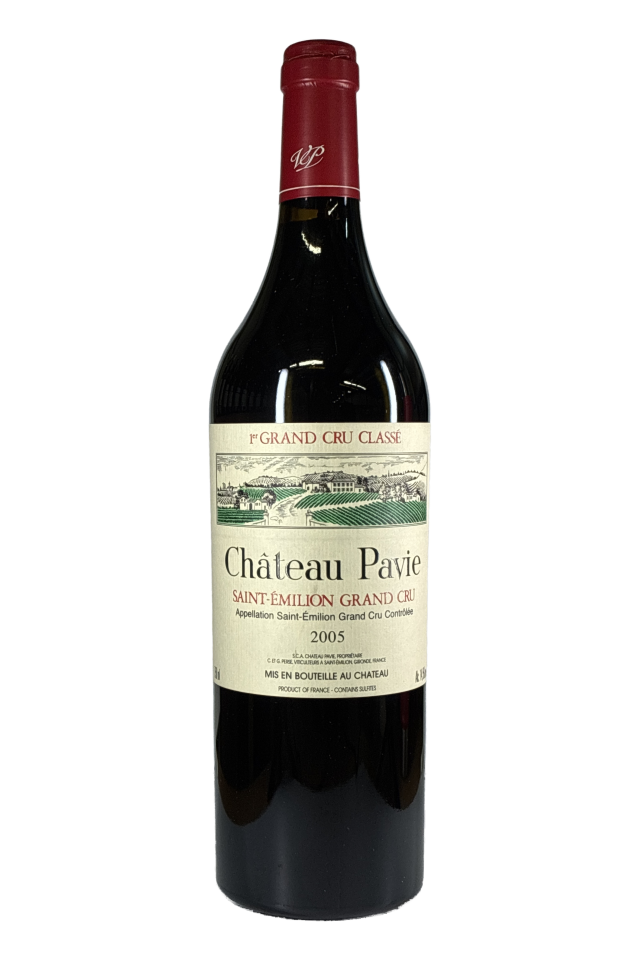
Very lightly bin soiled label.
Sold:
This auction has ended. Bidding is closed.
Collection name
Reviews
100RP
"Gérard Perse believes this is the greatest Pavie he’s made to date, although certainly I would argue that list includes the 2000, as well as the 2009 and 2010, among his superstars. This wine, which I had both in the 2005 horizontal report in the Wine Advocate, and at a mini-vertical with Perse at the restaurant Maison Boulud in Montreal, looks to be a 75- to 100-year wine. Dense, opaque purple to the rim, with a gorgeously promising nose of blackberries, cassis, graphite and cedar wood just beginning to emerge, it tastes more like a three-year-old than wine that is already a decade old. This beauty is intense and full-bodied, with magnificent concentration, a majestic mouthfeel and a total seamless integration of tannin, wood, alcohol, etc. Beautifully rich, full and multidimensional, this is a tour de force in winemaking and certainly one of the top dozen or so 2005 Bordeaux . . . . drink it over the following 50-100 years! Pavie is widely acclaimed as one of Bordeaux’s greatest terroirs, of largely limestone and clay soils. Brilliantly situated with a sunny, southern exposure and exceptional drainage, Pavie potentially rivals nearby Ausone, the oldest and possibly the most famous estate in Bordeaux. Pavie’s other nearby neighbors include, Pavie-Macquin and Troplong-Mondot to the north, Larcis-Ducasse to the southeast and La Gaffelière and Saint-Georges Côte Pavie to the west . . . . In short, [owners Chantal and Gérard Perse] dramatically raised the quality. Currently, the vineyard is planted with 60% Merlot, 25% Cabernet Franc and 15% Cabernet Sauvignon, but the actual blend for each vintage tends to possess slightly higher amounts of Merlot. A perfectionist, owner Gérard Perse is flexible with the percentage of new oak, as well as how long the wine is aged in cask. Great vintages can get 100% new oak and spend up to 32 months in barrel. Lesser years are bottled after 18 months and see at least 30% less new oak. There is no fining or filtration. The resulting wine has been considered one of the superstars of Bordeaux since 1978.
Region
Red
Country
Score
"Gérard Perse believes this is the greatest Pavie he’s made to date, although certainly I would argue that list includes the 2000, as well as the 2009 and 2010, among his superstars. This wine, which I had both in the 2005 horizontal report in the Wine Advocate, and at a mini-vertical with Perse at the restaurant Maison Boulud in Montreal, looks to be a 75- to 100-year wine. Dense, opaque purple to the rim, with a gorgeously promising nose of blackberries, cassis, graphite and cedar wood just beginning to emerge, it tastes more like a three-year-old than wine that is already a decade old. This beauty is intense and full-bodied, with magnificent concentration, a majestic mouthfeel and a total seamless integration of tannin, wood, alcohol, etc. Beautifully rich, full and multidimensional, this is a tour de force in winemaking and certainly one of the top dozen or so 2005 Bordeaux . . . . drink it over the following 50-100 years! Pavie is widely acclaimed as one of Bordeaux’s greatest terroirs, of largely limestone and clay soils. Brilliantly situated with a sunny, southern exposure and exceptional drainage, Pavie potentially rivals nearby Ausone, the oldest and possibly the most famous estate in Bordeaux. Pavie’s other nearby neighbors include, Pavie-Macquin and Troplong-Mondot to the north, Larcis-Ducasse to the southeast and La Gaffelière and Saint-Georges Côte Pavie to the west . . . . In short, [owners Chantal and Gérard Perse] dramatically raised the quality. Currently, the vineyard is planted with 60% Merlot, 25% Cabernet Franc and 15% Cabernet Sauvignon, but the actual blend for each vintage tends to possess slightly higher amounts of Merlot. A perfectionist, owner Gérard Perse is flexible with the percentage of new oak, as well as how long the wine is aged in cask. Great vintages can get 100% new oak and spend up to 32 months in barrel. Lesser years are bottled after 18 months and see at least 30% less new oak. There is no fining or filtration. The resulting wine has been considered one of the superstars of Bordeaux since 1978.
Have questions?
French wine covers a remarkable range of styles, from the structured reds of Bordeaux to the sparkling wines of Champagne, where a second fermentation in the bottle creates the bubbles. Bordeaux is best known for red blends built around Cabernet Sauvignon or Merlot, but it also makes dry whites and the sweet wines of Sauternes. Burgundy is a benchmark for Pinot Noir and Chardonnay, with wines that can taste distinctly different from one village to the next. The Rhône Valley offers a contrast within a single region: Syrah shapes the reds of the north, while Grenache often leads the blends of the south. In the Loire Valley, Chenin Blanc can be dry, sweet or sparkling, while Cabernet Franc is the signature red grape of appellations such as Chinon and Saumur-Champigny. A French wine label often starts with a place name. The Appellation d’Origine Contrôlée (AOC) identifies a defined area and sets rules for permitted grapes and production. Learning a few appellation names makes it easier to recognize the styles you enjoy and find related wines from neighboring villages or other producers.
The world's largest fine-wine region, built around blends of Cabernet Sauvignon and Merlot. Divided by the Gironde estuary into the structured Left Bank and the plush, Merlot-led Right Bank, it is the historic benchmark for age-worthy claret and sweet Sauternes.
Chateau Pavie is a Saint-Emilion estate owned by Gerard Perse, ranked Premier Grand Cru Classe (A) in the 2012 classification, known for powerful, dense and richly concentrated wines from its limestone hillside.
Merlot is a red grape valued for generous fruit, a rounded palate and a supple, often velvety texture. Plum and cherry are characteristic flavors, sometimes accompanied by violet or fig, with chocolate, coffee and savory notes developing in some wines as they mature. Its styles range from bright, approachable reds to deeply concentrated wines with substantial structure. Bordeaux is Merlot's historic home, and the grape is particularly important on the Right Bank in Saint-Émilion, Pomerol and Fronsac. There it can lead a blend, frequently partnered with Cabernet Franc. Across Bordeaux, Merlot also complements Cabernet Sauvignon, contributing fruit and roundness alongside the latter's firmer tannic framework. Merlot generally ripens earlier than Cabernet Sauvignon, helping growers achieve ripe fruit in a range of conditions. Vineyard site, harvest timing and cellar choices determine the final balance of richness, freshness and tannin. Many bottlings offer pleasure in their youth, while fine, well-balanced examples can develop layered aromas and greater complexity through extended aging.